 Dorsum – The Ethnopolitcal Blog Worldwide Ethnopolitical Analyses
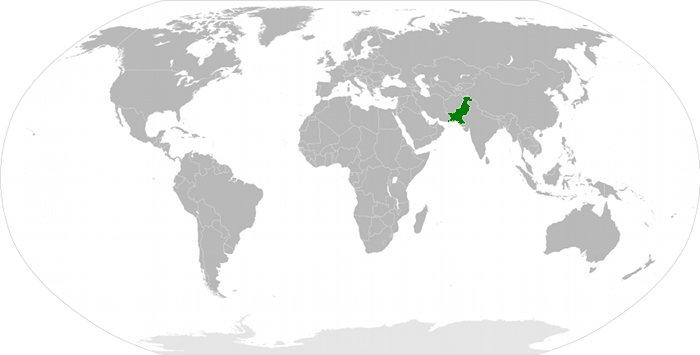
Until the Soviet invasion of Afghanistan in 1979, few people knew about either Afghanistan or Pakistan. It was through the struggle against the Soviet Union that the West became increasingly aware of this region of the world. The Mujahideen, the heroes of the Hindu Kush who drove the communists out of the country, were admired all over the world. The West feared that the Soviet Union would increase its influence as far as the Indian Ocean and the Gulf of Persia, and was determined to avoid this at all costs. Only one country was considered as a strategic partner: Pakistan. Iran, which had long been the U.S.’s main partner in the Gulf region, had severed ties with the ‘Sheitan Akbar’ (Great Satan) following the Islamic Revolution under Khomeini.
This demonstrates the absolute importance of Pakistan in the fight against the Soviet occupation of Afghanistan. There was no alternative, and thus circumstances developed a strong relationship between the U.S. and Pakistan. The important role of the military in Pakistan, which acts as a kind of national binder, may have been beneficial here. The military is firmly rooted in British tradition, so cultural understanding between the U.S. and Pakistan must have been straightforward at this level.
The consequences of the invasion
The consequences of the Soviet invasion were devastating for Afghanistan and Pakistan. It is estimated that between 1 and 2 million Afghans died, and around 10 million fled the country, with two thirds of them going to Pakistan. This meant that almost 10 per cent of Pakistan’s population in the 1980s (around 80 million people) were refugees. This had enormous consequences for Pakistan. In contrast, even 25,000 refugees from North Africa are deemed unacceptable by Europe, despite having a population of 500 million.
Artificial boundary – the Durand Line
The large number of refugees Pakistan has taken in shows the great affinity between Pakistanis and Afghans. This is mainly for ethnic reasons. The northwestern border of Pakistan was created during the British Raj (the British colonial era) and stretches 2,500 km directly through Pashtun territory. Pashtuns represent the largest ethnic group in Afghanistan.
This boundary line is known as the Durand Line, named after the British colonial administration’s foreign secretary, Sir Mortimer Durand. The British fought a total of three wars against Afghanistan; the first two were probably the most significant. The first Anglo-Afghan War (1839–1842) was lost by the British, which was a traumatic experience for them as they had enjoyed considerable success on the Indian subcontinent. It was only in the Second Anglo-Afghan War that the British were able to establish themselves, enforcing their territorial gains in 1880 with the aforementioned Durand Line.
Map of the Land of the Pashtuns
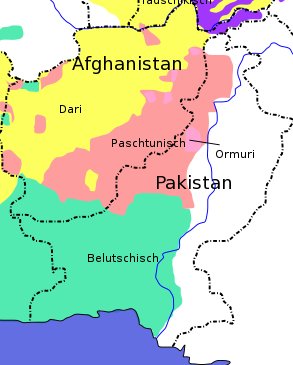
Afghanistan’s influence in Pakistan
In theory, one could argue that part of Afghanistan lies within Pakistan. It is also clear that political affiliations in the north-west region are inevitable. In addition, there are many refugees who have settled mainly in larger cities such as Islamabad, Karachi and Lahore. If Pakistan is currently viewed as an unreliable partner in the fight against terrorism, this situation must be taken into account. The central government, which has already navigated a long-standing political storm, has only limited influence over Afghan-Pakistani relations. A state official from Karachi who works in north-west Pakistan is indeed in Pakistan but is considered a stranger in practice. This is not due to xenophobia, but rather a degree of detachment. However, an Afghan Pashtun moves around north-west Pakistan like a local.
Moreover, following the British withdrawal and Pakistan’s subsequent independence, some people were ambitious to reunify northwestern Pakistan with Afghanistan. This demand is not particularly strong today, but it puts pressure on the government to leave the north-west alone and grant it much political autonomy.
Conclusions
Past events explain why Pakistan’s northwestern region occupies a special position within Pakistan and shares strong ties with Afghanistan. Sometimes, the bond between northwestern Pakistan and Afghanistan is stronger than that between northwestern Pakistan and the rest of Pakistan. This means that there are always groups in Pakistan supporting the Afghan Taliban and al-Qaida members loyal to them. In this case, the central government is virtually powerless, since the region is practically beyond the reach of official agencies. This situation is comparable to the Mafia in southern Italy, where a state within a state exists and the central Italian government is also powerless. In recent decades, Pakistan has demonstrated its commitment to fighting alongside the West, making many sacrifices in the process. However, the state does not control all parts of the country, and regions such as the Northwest seem to be beyond the central government’s control.